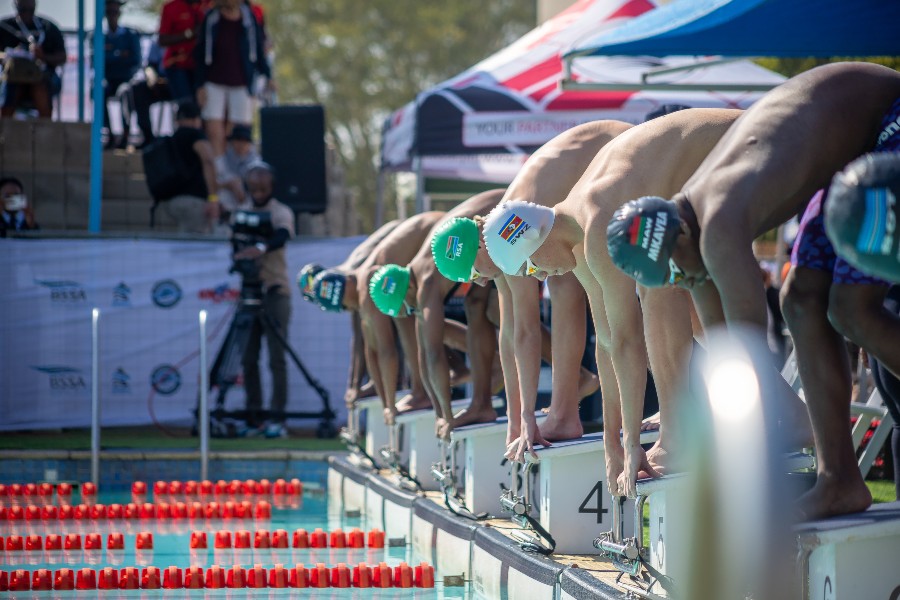
An analytical review of the XXII Africa Aquatics Zone IV Swimming Championships 2026
GABORONE, Botswana – September 2026 – Namibia went home as Zone IV champions, South Africa as the nation with the most gold medals, and Botswana as hosts who finished third on points with more individual medals than anyone bar the top two. Those three facts are consistent with each other, and the reason they are consistent is the most useful thing the week in Gaborone has to teach. This piece works through the full dataset of the championships, 1,597 individual swims by 298 athletes from 13 nations across 120 individual events and 14 relays, to explain how the title was won, where each nation's strength actually sits, what the seed-time data reveals about how swimmers in this region prepare and race, and what the numbers suggest for the federations planning towards 2027. Masters exhibition events are excluded throughout.
1. Three ways to win, and three winners
The championship trophy is decided on team points, awarded to the top finishers in every individual and relay event. That system rewards breadth: a nation that puts a swimmer in the top eight of every final scores more than one that wins half the finals and is absent from the rest. On that measure Namibia were the clear champions, topping the session points in six of the seven sessions.
The medal table tells a different story. South Africa won 41 individual golds to Namibia's 38, and 89 individual medals to 86, from a delegation of 21 athletes against Namibia's 30. Per athlete, South Africa's return was 4.24 individual medals; Namibia's 2.87; nobody else's above 1.5.
Botswana's third place on points came from volume. The hosts fielded 41 athletes, second only to Zimbabwe's 42, recorded 203 individual swims, second only to Namibia's 207, and won 41 individual medals, but only six of them gold. Fourteen of those 41 athletes were seniors, and the senior group won 22 medals between them, more than any other nation's seniors except Namibia's. Botswana's programme is built for consistent scoring, not for the top step, and the points table rewarded it exactly for that.
The three results are three different answers to the question "who was best?", and each nation was best at something different.
2. The age-group map
Where a nation's golds come from says more about its programme than how many it has. The split of the 119 individual titles decided by a race (one event had a single entrant) is stark.
| Nation | 11-12 | 13-14 | 15-16 | 17 & Over | Total golds |
|---|---|---|---|---|---|
| South Africa | 0 | 21 | 20 | 0 | 41 |
| Namibia | 7 | 0 | 8 | 23 | 38 |
| Zimbabwe | 4 | 7 | 1 | 2 | 14 |
| Seychelles | 8 | 0 | 0 | 0 | 8 |
| Botswana | 4 | 0 | 1 | 1 | 6 |
| Mauritius | 3 | 0 | 0 | 3 | 6 |
| Zambia | 4 | 0 | 0 | 0 | 4 |
| Angola | 0 | 2 | 0 | 0 | 2 |
| Eswatini | 0 | 0 | 0 | 1 | 1 |
South Africa brought no 11-12 swimmers at all and only two seniors. Nineteen of their 21 athletes were aged 13 to 16, and in those two age groups they won 41 of the 60 available titles, 68 per cent. Their delegation was not a national team in the usual sense; it was a targeted age-group squad, and it did exactly what it was sent to do.
Namibia own the senior ranks. Twenty-three of the 29 titles in the 17 & Over category went to Namibian swimmers, chiefly Jessica Humphrey (8), Oliver Durand (8), Luke Beukes (3) and Molina Smalley (2). Add seven golds in the 11-12 age group, where Patrick Durand and Oelof Badenhorst met in six finals and split them four-two, and eight at 15-16, and Namibia's programme covers every age band except 13-14, where they took three medals and no gold.
Seychelles' eight golds all came from the 11-12 age group, six from Conrad Opperman and two from Emma Liu-Chit-Chon. Zambia's four golds were all 11-12 girls: Isabella Hesse, Namwezi Mulligan and Tamika Njovu. Zambia sent twelve 11-12 swimmers, the largest youth group of any nation, and every one of their 15 medals was won by a girl.
Zimbabwe were the second force in the 13-14 age group with seven golds and 23 medals, through Kaylea Rogers, Amaranthine Dunkley, J Wes Jared and Tatenda Mujati, and picked up four more titles at 11-12 through Wade Cameron and Ruvarashe Mukungunugwa.
The implication for 2027 is simple. South Africa's 13-14 group becomes next year's 15-16 group and their 15-16 group becomes seniors, where Namibia have been unchallenged. Namibia's 11-12 group moves into the 13-14 category South Africa dominated. The two nations have been strong in complementary bands; next year they collide.
3. Seed-time conversion: the myth of the morning and the reality of the fourth day
Of the 1,559 timed swims, 605 (38.8 per cent) were faster than the swimmer's entry time. The pattern beneath that figure is the most instructive in the dataset.
Age is the dominant variable. Swimmers aged 11-12 improved on 59 per cent of their swims, with a median improvement of 0.8 per cent. At 13-14 the rate fell to 39 per cent; at 15-16 to 29 per cent; at 17 & Over to 23 per cent, with a median swim 1.95 per cent slower than seed. Younger swimmers are improving between meets faster than their entry times can keep up; senior swimmers are entering at or near lifetime bests and, for the most part, not reaching them here.
Boys converted better than girls, 43.5 per cent to 33.9 per cent, across every age group. The gap is consistent enough to be worth a coaching conversation rather than dismissed as noise.
The morning session had no effect. Morning swims converted at 38.5 per cent, evening swims at 38.9 per cent. The intuition that distance and 200m events swum before lunch are inherently slower is not supported by this data; what the morning sessions contained (800m, 200m breaststroke and backstroke, 400m, 100m butterfly) explains their lower rates, not the time of day.
The fourth day was the problem, and the weather was most of the reason. Conversion fell from 51 per cent on the first evening to 24 per cent on the final day. Two things happened. A lightning storm on the Thursday evening curtailed the Day 3 session before its programme was complete, and the first two events scheduled for that evening, the Girls and Boys 11-12 50m Freestyle, were carried over to Saturday. Then Saturday itself dawned cold and windy, conditions that matter a great deal in an outdoor pool: cold air and wind on wet skin between the marshalling area and the blocks, and on the deck between events, drain warmth and readiness from swimmers in a way an indoor venue never asks of them. The individual medley, contested only on Day 4, converted at 18 per cent, the worst of any stroke; freestyle at 34 per cent; the three form strokes between 42 and 45 per cent. Fifty-metre events converted at 46 per cent, 200m events at 33 per cent.
Fatigue compounded it. The final day carried 32 individual finals plus the two displaced events, more than any other session, and 64 athletes swam eight or more individual events across the week, with Botswana's Jade Chilisa swimming 13. By Saturday the field was tired, cold and racing a longer programme than planned, and the seed data records all three.
The medal band did not convert best. Swimmers finishing fourth to eighth improved on 43 per cent of their swims; medallists on 40 per cent; swimmers ninth and below on 35 per cent. The swimmers just outside the medals were the ones most often swimming personal bests.
4. Conversion by nation, and what it says about entry culture
| Nation | Timed swims | Improved | Rate |
|---|---|---|---|
| Madagascar | 30 | 18 | 60% |
| Malawi | 84 | 46 | 55% |
| Botswana | 200 | 98 | 49% |
| Angola | 157 | 72 | 46% |
| Zimbabwe | 180 | 77 | 43% |
| Eswatini | 89 | 37 | 42% |
| Zambia | 149 | 57 | 38% |
| Seychelles | 119 | 39 | 33% |
| South Africa | 125 | 40 | 32% |
| Namibia | 206 | 64 | 31% |
| Mozambique | 159 | 45 | 28% |
| Mauritius | 61 | 12 | 20% |
The ranking is almost the inverse of the medal table. That is not a paradox. Nations with fewer competitive opportunities between championships tend to enter with seed times that are months old, from short-course pools, or hand-timed, and their swimmers beat them comfortably. Nations with dense domestic calendars enter with recent long-course bests that are hard to repeat. Malawi's 55 per cent and Madagascar's 60 per cent are a sign of development happening between meets, not of superior preparation; South Africa's 32 per cent is a sign of accurate seeding, not of underperformance.
Two outliers deserve attention. Mozambique's 28 per cent, from a delegation of 26 with six swims per athlete, is low for a developing programme and suggests either optimistic entry times or a heavy schedule. Mauritius's 20 per cent, from a small squad that won six golds, suggests a team that peaked before Gaborone.
5. How competitive were the finals?
The top seed won 87 of the 119 contested finals, 73 per cent. Ten finals were decided by less than a tenth of a second, 25 by less than half a second, and 49 by less than one second. Eleven were decided by more than ten seconds, almost all in the 17 & Over category, where fields averaged nine swimmers against fourteen to fifteen in the youth age groups and the winning margin averaged 4.9 per cent of the winning time.
Girls' finals were the closer ones. The median winning margin in girls' events was 1.35 seconds against 2.28 in boys', and the top seed won 36 of 59 girls' finals against 51 of 60 boys'. The boys' events in Gaborone were more predictable; the girls' events were where the upsets happened.
The season's rivalries, measured by direct meetings:
- Kaylea Rogers (ZIM) v Tyla Thomas (RSA): seven meetings, Rogers ahead in five, Thomas ahead in the two that produced her golds and her championship record.
- Conrad Opperman (SEY) v Wade Cameron (ZIM): nine meetings, Opperman ahead in seven; Cameron's two wins came in the 50m Backstroke and 50m Freestyle.
- Gio Cocci v Reba Moleko (RSA): seven meetings, Cocci ahead in all seven; Moleko took seven silvers and two records of his own.
- Oelof Badenhorst v Patrick Durand (NAM): six meetings, Badenhorst four, Durand two.
- Oliver Durand (NAM) v Rayhan Khonat (BOT): four meetings, Durand three, Khonat one; margins of 0.77, 1.40, 0.09 and 1.22 seconds.
- Jessica Humphrey v Molina Smalley (NAM): four meetings, Humphrey four.
6. Records
Thirty-seven swims were flagged as championship records on the official sheets, 30 of them winning individual swims, four winning relays and three second-place swims that also bettered the previous mark. By age group the individual records fell ten each at 13-14 and 15-16, eight at 17 & Over and four at 11-12. By nation, South Africa set 17, Namibia 11, Zimbabwe 3 and Seychelles 1. Gio Cocci alone set six, more than any nation other than his own and Namibia.
Two caveats matter. The Day 1 sheets carried no record data, so nothing from the opening day was flagged; Cocci's 57.98 in the 100m Backstroke and Oliver Durand's 58.26 are the obvious candidates for retrospective checking. And the Day 4 export overwrote the record file before it was issued, so the previous marks for 15 of the 17 Day 4 records are not visible; several 17 & Over and 200m Butterfly entries may be inaugural standards rather than broken records.
7. Depth versus stars
How many different swimmers won a nation's medals is a better guide to the health of a programme than the medal count itself.
| Nation | Individual medals | Unique medallists | Share won by top three athletes |
|---|---|---|---|
| South Africa | 89 | 20 | 31% |
| Namibia | 86 | 20 | 31% |
| Botswana | 41 | 16 | 44% |
| Zimbabwe | 44 | 13 | 50% |
| Seychelles | 29 | 10 | 69% |
| Zambia | 15 | 7 | 60% |
| Mozambique | 12 | 7 | 67% |
| Mauritius | 16 | 5 | 75% |
| Eswatini | 11 | 4 | 91% |
| Angola | 7 | 4 | 86% |
| Malawi | 6 | 3 | 100% |
| Madagascar | 3 | 2 | 100% |
South Africa and Namibia each spread their medals across 20 swimmers, with their three best accounting for less than a third. Botswana's 16 medallists is the third-widest base in the region. At the other end, Eswatini's 11 medals came almost entirely from Hayley Hoy, Luca Fraser and Damien De Sousa; Angola's from the two Lukenya Morais sisters-in-name and Beatriz Scott; Malawi's from Davina Chongwe and Tasunje Mkavea. Those programmes have proved they can produce a medallist; the next step is producing several at once.
Gender balance is uneven in ways that point at pipelines. Zambia's 15 medals were all won by girls; Seychelles' 29 split 20 boys to 9 girls; Mauritius's 16 split 12 girls to 4 boys; Angola's seven, six girls; Madagascar's three, all boys.
8. What the numbers suggest for 2027
For Namibia, the challenge is the 13-14 age group, the one band where the programme produced no gold, and the graduation of its senior core; Humphrey, Durand and Beukes will still be eligible, but the 11-12 group that produced seven golds needs a bridge.
For South Africa, the question is whether the selectors broaden the delegation to include 11-12 and senior swimmers, which would put the points title within reach, or keep sending a targeted age-group squad and accept second on points as the price of a 68 per cent gold rate in the bands they contest.
For Botswana, third on points with six golds is a base to build upward from rather than outward: a 41-strong team that converted 49 per cent of its swims has the numbers; what it lacks is the two or three swimmers per age group who can win.
For Zimbabwe, Seychelles, Zambia and Mauritius, each has a demonstrated strength in a single age band or gender. The developmental question is continuity: whether Rogers, Cameron, Opperman, Hesse, Mulligan and Zuel are still swimming, and still improving, in two years.
For Angola, Eswatini, Malawi, Mozambique and Madagascar, the conversion rates show programmes that are improving faster than their entry times, which is exactly what development looks like from the inside. The medal counts will follow the depth.
And for Lesotho, four swimmers, twelve swims, twelve finishes and a 5.7-second improvement inside three days is the beginning of a record.