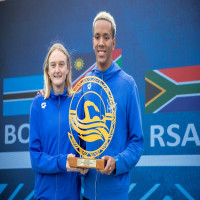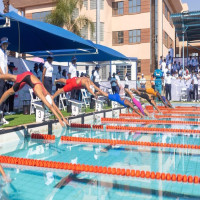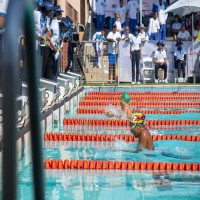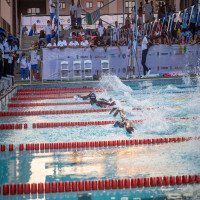
World Aquatics Swimming World Cup 2026 – Stop 1 | Baku, Azerbaijan | 1–3 October 2026 (25m pool) Nations analysed: South Africa, Algeria, Botswana, Namibia (plus South Africa's Rebecca Meder, entered under the Club Swimmers banner)
Key Findings
- South Africa won all six African medals from 18 finals and five top-eight timed-final placings. About one in four of those podium opportunities became a medal. Pieter Coetze won four of the six medals, from four finals.
- Three medals were decided by 0.03 seconds each. Houlie missed gold by 0.03, Coetze missed gold in the 100m IM by 0.03, and Canny missed silver by 0.03. Together, 0.09 seconds stood between South Africa's actual haul and two more golds and an extra silver.
- South African breaststroke has a back-half problem. Houlie and Canny led or matched the medal winners at halfway in three separate finals and lost ground over the closing length each time. The front-end speed is world class; the finish is where the medals were lost.
- Coetze is winning races on the last 25 metres. He had the fastest closing 25m of any finalist in both the 50m and 100m backstroke. His 50m backstroke deficit came entirely in the first 25m, before he surfaced.
- Butterfly is Africa's clearest gap. Africa had no finalists in any of the six butterfly events, and its average butterfly score (659 points) was the lowest of the five stroke groups.
- Africa's heats-to-final improvement matched the global field. African finalists improved by an average of 1.00% from heats to final, against 1.09% for the rest of the field. Fifteen of the 18 African swims improved.
- The development pipeline is wide but has a long way to go. Eight of Africa's 21 swimmers were 17 or younger. Their average score of 619 points is 157 points below Africa's senior swimmers (776) and 184 points below the meet median (803).
Method and Data
This analysis uses the official Swiss Timing results export (LENEX) for the meet. Performance is compared using the World Aquatics points printed in that file, a scoring system that allows swims across different events and distances to be compared on a single scale.
Two benchmarks are used throughout:
- Meet median: 803 points. This is the median of all 870 scored swims at the meet, finals and heats combined.
- Finals median: 846 points. This is the median of all swims in finals.
"Finals" means heats-and-final events and straight finals. The 400m, 800m and 1500m freestyle were timed finals, ranked across all heats, and are counted separately as top-eight placings. Split and reaction-time analysis uses the official electronic timing data. Entry times are not used to judge improvement, because most appear to be long-course marks.
1. Continental Overview
| Nation | Swimmers | Swims | Avg. Points | Median | Swims ≥800 | Finals | Medals |
|---|---|---|---|---|---|---|---|
| South Africa | 12 | 62 | 766 | 786 | 30 (48%) | 18 | 6 (2-2-2) |
| Algeria | 6 | 19 | 617 | 600 | 0 | 3* | 0 |
| Botswana | 1 | 4 | 714 | 751 | 0 | 0 | 0 |
| Namibia | 1 | 5 | 613 | 618 | 0 | 0 | 0 |
| R. Meder (Club Swimmers) | 1 | 8 | 817 | 822 | 5 (63%) | 4 | 0 |
| Africa total | 21 | 98 | 732 | – | 35 (36%) | 25 | 6 |
*Two of Algeria's three finals were straight finals with no heats (women's 200m breaststroke).
Africa's 98 scored swims averaged 732 points, 71 below the meet median. Only about a third of African swims reached the median. Those figures conceal a two-speed continent. South Africa's 12 swimmers put nearly half their swims above 800 points, while no swim from Algeria, Botswana or Namibia reached that level. South Africa's top tier competes at the level of the finals. The rest of the continent is working towards the middle of the heats.
2. South Africa
Tier 1: Medal winners
Pieter Coetze – 9 swims | best 947 pts (50m backstroke) | average 871 | 4 finals, 4 medals, 2 African records
Coetze was South Africa's outstanding performer and the highest-scoring African swimmer at the meet. His two best swims, 947 points for the 50m backstroke and 943 for the 100m, were both African records.
The race data shows a clear pattern:
- Closing speed is his weapon. He swam the fastest last 25m of the field in the 50m backstroke (11.36) and the 100m backstroke (12.67). In the 100m he was 0.03, 0.04 and 0.01 behind Samusenko at the 25m, 50m and 75m marks, then out-split him by 0.14 on the final length to win by 0.13.
- The start is where the 50m was lost. Kornev reached 25m in 10.86, 0.29 ahead of Coetze (11.15), despite reacting more slowly off the blocks (0.68 to Coetze's 0.64). The difference was in the underwater phase and breakout, not the reaction. Coetze then out-split Kornev on the second length but could not close a 0.29 gap.
- The 200m was won from the front. Coetze built a 1.74-second lead by halfway and only had the seventh-fastest final 50m (28.52). The win was secured early rather than on the finish.
- He makes big gains between heats and finals. He improved by 4.07 seconds in the 200m backstroke (3.6%), 1.44 in the 100m IM and 1.25 in the 100m backstroke. In two of his four finals he qualified outside the top two.
- His 100m IM bronze came while doubling. It was swum in the same session as his 200m backstroke gold. He was level with eventual winner Barr at 75m (38.51 to 38.52) and finished 0.03 behind.
His only non-final swim was the 100m freestyle, where he missed the ten-lane final by 0.02 seconds.
Michael Houlie – 5 swims | best 914 pts (50m breaststroke) | average 865 | 2 finals, 1 medal
Houlie had the second-highest average of any African. Both his breaststroke swims scored above 910 points, well above the finals median. His starts were among the sharpest in the field: 0.59 and 0.61 reactions against final-field averages of 0.65.
The split data shows where the gold went. In the 50m breaststroke he led at 25m (11.63 to Qin's 11.69) and was overtaken on the second length (14.07 to 13.98). In the 100m breaststroke he turned first at 50m (25.97, ahead of eventual winner Prigoda's 26.06). Prigoda was ahead by 75m, and Houlie's closing 50m of 31.05, against Prigoda's 30.02, dropped him from first at halfway to fifth.
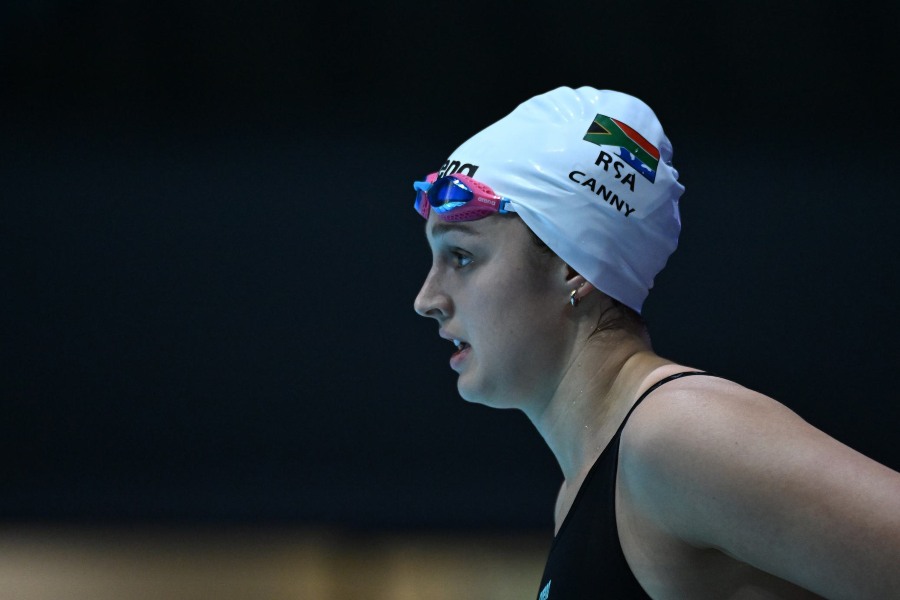
Aimee Canny – 8 swims | best 876 pts (100m breaststroke) | average 830 | 5 finals, 1 medal
Canny had the heaviest finals programme of any African: five finals across three days. She shows the same back-half pattern as Houlie:
- 100m breaststroke: she was fastest of the field at 50m (30.31), second at 75m, and then lost silver by 0.03 in the closing 25m (17.70 to Chikunova's 17.16).
- 50m breaststroke: she was third at 25m (13.79), then lost bronze by 0.11 on the second length.
Her reaction times (0.73–0.74) were slower than the final-field average (about 0.70) in every final. Gaining three hundredths off the blocks would have been worth a silver medal.
Her one heats-to-final regression (+0.71 in the 100m IM) came in the same session as her 200m breaststroke straight final. Her schedule, rather than her form, is the likely explanation.
Tier 2: Finalists
Matthew Caldwell – average 849 pts (third-highest African). He placed fourth in the 400m freestyle (883 pts), 0.20 off bronze, and fourth in the 1500m freestyle (850 pts). The 1500m is the most evenly paced distance swim by any African at the meet: his second 750m was only 0.93 slower than the first, and his last three 100m splits (59.06, 59.09, 58.28) were his fastest after the opening 100. The 400m tells a different story: a 4.77-second positive split after a 52.87 opening 100. He was 0.20 off bronze there, so a more even pace may be worth a medal. He was also eighth in the 200m freestyle final.
Guy Brooks – best 861 pts. Brooks made two finals: fifth in the 200m freestyle and eighth in the 100m freestyle. The 100m result understates his position: he was only 0.36 off bronze in an extremely compressed field behind runaway winner Kornev. He improved in both finals (by 0.13 and 0.84 seconds) and had the fourth-fastest closing 50m in the 200m final. His 400m freestyle shows the same finishing strength: his last 100m (57.50) was faster than his second and third.
Dune Coetzee – best 831 pts (200m freestyle). Her 800m freestyle (sixth) was a model of even pacing: the middle 100m splits varied by only 0.27 seconds, and she finished with her fastest 100 after the first (62.31). She moved from 10th qualifier to ninth in the 200m freestyle final.
Bailey Lambert (17) – best 711 pts. She made the biggest relative heats-to-final improvement by any African other than Coetze: 1.81 seconds (2.9%) in the 100m backstroke, finishing eighth. She was also fifth in the 200m backstroke straight final.
Tier 3: Development squad
| Swimmer | Age | Swims | Best (pts) | Average |
|---|---|---|---|---|
| Daena Robinson | 18 | 5 | 50m Breast heats (741) | 679 |
| Nicholas Trower | 17 | 4 | 100m Free heats (726) | 662 |
| Reuban Haylock | 19 | 3 | 200m Free heats (696) | 667 |
| Riley Hemphill | 17 | 3 | 100m Breast heats (656) | 635 |
| Shannon Hugo | 16 | 3 | 400m Free (648) | 627 |
Robinson reached the 200m IM straight final (eighth). Hugo's pacing data points to her clearest area for development. She was 7.59 seconds slower on the second half of the 400m freestyle and 8.45 seconds slower on the second half of the 800m. Dune Coetzee, in the same 800m, was only 1.30 slower on the second half.
3. Rebecca Meder (Club Swimmers)
Meder's average of 817 points across eight swims is higher than that of any South African national-team swimmer apart from Coetze, Houlie, Caldwell and Canny. She reached four finals, including two fourth places: the 100m breaststroke (0.36 off bronze) and the 200m IM (883 pts, her best score). She improved from heats to final in all three of her heats-and-final events.
In the 100m breaststroke final she had the third-fastest closing 25m of the field (17.55). That is the opposite of the pattern seen in Houlie and Canny, and suggests the back-half issue is not universal across South African breaststroke.
4. Algeria
Six swimmers | 19 swims | average 617 | best 799 (Benfekih, 50m freestyle final)
Algeria had the second-largest African team. It was also the youngest: four of its six swimmers were aged 16.
Mehdi Benfekih is a clear sprint specialist. He scored 786 in the 50m freestyle heats and 799 in the final, then dropped to 734 over 100m and 702 in the 50m butterfly. His 0.55 reaction time was the fastest in the 50m freestyle final, against a field average of 0.65. With no swim over 799 points, he is Algeria's only athlete currently close to the meet median. On these numbers, the 50m freestyle is his best route to further finals.
Moncef Benbara (20) and Houd Abed (16) both scored best over 200m (634 and 612) and worst over 50m (596 and 544). That suggests endurance-based backstroke profiles rather than sprint ones. The 22-point gap between the 16-year-old and his senior teammate in the 200m is small, and points to Abed's potential.
Salaheddine Torki (16) was strongest over 100m freestyle (703 pts), with a disqualification in the 100m butterfly heats.
Rahma Benmahammed and Kamelia Amalie Mezzaour (both 16) raced all three breaststroke distances. Both scored best over 100m (563 and 517). Their seventh and ninth places in the 200m straight final came 18–22% behind the winning time, an honest measure of the distance to world level for two swimmers at the very start of their international careers.
5. Botswana
Rayhan Khonat (18) | 4 swims | average 714 | median 751
Khonat had the highest median score of any non-South African team. Three of his four swims scored above 700, and his freestyle was remarkably consistent: 768 over 100m, 765 over 200m and 736 over 400m. The 200m IM (589) was his clear outlier, so the data marks him as a freestyle specialist.
His 400m pacing (55.47 / 59.51 / 60.59 / 59.51) dipped in the third 100 before recovering with a matched closing 100. That shows good finishing strength, and a more even middle section is the obvious target.
6. Namibia
Corne le Roux (24) | 5 swims | average 613 | best 635 (400m freestyle)
Le Roux carried the heaviest event load of any swimmer from a single-athlete team, racing five events across all three days. His scores fell in a narrow 580–635 band across three different strokes: freestyle, butterfly and IM. That is the profile of a versatile all-rounder without a dominant event. His best placing was 13th in the 200m butterfly (2:04.65, 629 pts).
His 400m freestyle 100m splits slowed steadily (58.66, 62.18, 62.52, 63.52). Unlike Khonat, he had no finishing kick, so back-half endurance is the main area for development.
7. Cross-Cutting Analysis
Margins: where medals were won and lost
| Swimmer | Event | Result | Margin |
|---|---|---|---|
| Michael Houlie | 50m Breaststroke | Silver | 0.03 from gold |
| Pieter Coetze | 100m IM | Bronze | 0.03 from gold |
| Aimee Canny | 100m Breaststroke | Bronze | 0.03 from silver |
| Aimee Canny | 50m Breaststroke | 4th | 0.11 from bronze |
| Matthew Caldwell | 400m Freestyle | 4th | 0.20 from bronze |
| Rebecca Meder | 100m Breaststroke | 4th | 0.36 from bronze |
| Guy Brooks | 100m Freestyle | 8th | 0.36 from bronze |
| Pieter Coetze | 100m Freestyle heats | 11th | 0.02 from final |
The four non-medal near misses add up to 1.03 seconds. Closing that gap could realistically have doubled Africa's bronze count.
Stroke profile
| Stroke | African swims | Avg. Points | Best | Finalists |
|---|---|---|---|---|
| Backstroke | 17 | 721 | 947 | Coetze, Lambert |
| Breaststroke | 24 | 734 | 914 | Houlie, Canny, Meder, Algerian pair (straight final) |
| Freestyle | 37 | 744 | 883 | Brooks, Caldwell, D. Coetzee, Benfekih (plus timed-final top eights) |
| Individual Medley | 13 | 747 | 883 | Coetze, Canny, Meder, Robinson |
| Butterfly | 7 | 659 | 730 | None |
Backstroke has Africa's highest peak, but its average is pulled down by the development swimmers. Butterfly is the only stroke group with no African finalist and no swim above 730 points. Only seven butterfly swims were scored, with one more ending in a disqualification and another a non-start. Butterfly is under-entered as well as under-performing.
Heats-to-final conversion
African finalists improved by an average of 1.00% between heats and finals, almost exactly the field average of 1.09%. Fifteen of 18 African swims got faster (83%, against 81% across the field). All three regressions had context:
- Canny, 100m IM (+0.71): she was doubling up, as noted above.
- Houlie, 100m breaststroke (+0.04): the fade over the final length.
- Caldwell, 200m freestyle (+0.12): his fourth race of a heavy distance programme, which included the 1500m.
Starts
Away from backstroke, Africa's average reaction time was 0.70, against a field average of 0.68. That is effectively the same. The picture varies by athlete. Houlie (0.59–0.61) and Benfekih (0.55) were among the quickest off the blocks in their finals, while Canny (0.73–0.74) was consistently among the slowest.
Age profile
| Group | Swimmers | Swims | Avg. Points |
|---|---|---|---|
| 17 and under | 8 | 28 | 619 |
| 18 and over | 13 | 70 | 776 |
The under-18 group scored 157 points below the seniors on average. Lambert was the only under-18 swimmer to reach a heats-and-final final. Algeria accounts for half of the under-18 group, which makes its programme the continent's broadest youth investment at this meet.
8. Outlook
South Africa leaves Baku with a front line that can win World Cup medals: Coetze, Houlie, Canny and, increasingly, Caldwell. The margins analysis shows that improving the back half of breaststroke races and Coetze's underwater phase in the 50m backstroke are the most valuable targets. Each relates to a race already lost by hundredths. Brooks and Meder are within half a second of a podium.
For the rest of Africa, the data argues for patience and precision. Benfekih's sprint-only profile gives him a clear focus event. Khonat's freestyle consistency is a platform to build on. Algeria's four 16-year-olds gained exposure that most developing swimmers do not get until much later. Across the continent, butterfly and back-half endurance stand out as the two gaps to address before the next stops of the circuit.
Appendix: African Swimmers Ranked by Best Score
| Rank | Swimmer | Nation | Best (pts) | Event | Swims | Average |
|---|---|---|---|---|---|---|
| 1 | Pieter Coetze | RSA | 947 | 50m Back (F) | 9 | 871 |
| 2 | Michael Houlie | RSA | 914 | 50m Breast (F) | 5 | 865 |
| 3 | Rebecca Meder | Club Swimmers | 883 | 200m IM (F) | 8 | 817 |
| 3 | Matthew Caldwell | RSA | 883 | 400m Free (TF) | 4 | 849 |
| 5 | Aimee Canny | RSA | 876 | 100m Breast (F) | 8 | 830 |
| 6 | Guy Brooks | RSA | 861 | 100m Free (F) | 7 | 792 |
| 7 | Dune Coetzee | RSA | 831 | 200m Free (F) | 5 | 773 |
| 8 | Mehdi Benfekih | ALG | 799 | 50m Free (F) | 4 | 755 |
| 9 | Rayhan Khonat | BOT | 768 | 100m Free (H) | 4 | 714 |
| 10 | Daena Robinson | RSA | 741 | 50m Breast (H) | 5 | 679 |
| 11 | Nicholas Trower | RSA | 726 | 100m Free (H) | 4 | 662 |
| 12 | Bailey Lambert | RSA | 711 | 100m Back (F) | 6 | 676 |
| 13 | Salaheddine Torki | ALG | 703 | 100m Free (H) | 3 | 662 |
| 14 | Reuban Haylock | RSA | 696 | 200m Free (H) | 3 | 667 |
| 15 | Riley Hemphill | RSA | 656 | 100m Breast (H) | 3 | 635 |
| 16 | Shannon Hugo | RSA | 648 | 400m Free (TF) | 3 | 627 |
| 17 | Corne le Roux | NAM | 635 | 400m Free (TF) | 5 | 613 |
| 18 | Moncef Benbara | ALG | 634 | 200m Back (H) | 3 | 621 |
| 19 | Houd Abed | ALG | 612 | 200m Back (H) | 3 | 581 |
| 20 | Rahma Benmahammed | ALG | 563 | 100m Breast (H) | 3 | 535 |
| 21 | Kamelia Amalie Mezzaour | ALG | 517 | 100m Breast (H) | 3 | 505 |
F = final; TF = timed final; H = heats. Averages exclude DNS/DSQ swims.